Sunday, November 24, 2013

Luxury At Any Price

1.  DALLAS, TX.- A one of a kind Hermès 32cm Matte Geranium Porosus Crocodile & Black Togo Leather Sellier Kelly Bag with Feet, quite possibly the rarest and most-sought after Kelly bag in existence, is expected to bring more than $50,000 as the lead lot of Heritage Auctions' Dec. 10-11 Holiday Luxury Accessories Signature® Auction. It's a one-of-a-kind, special edition piece that carried an original retail price of nearly $60,000.
"All Hermès lovers have to hear is that this bag is one-of-one and they will know that it is an extraordinary piece," said Matt Rubinger, Director of Luxury Accessories at Heritage. "It was created as part of the whimsical and exclusive Petit H Exhibition and could be the most collectible bag in the world."
The auction is one of the largest and most important sales that the luxury accessories market has ever seen. It will take place in Dallas, Texas after a three-city tour and preview of the pieces.
The serious Hermès collector is sure to be drawn to the most impressive selection of ultra-exclusive and popular bags from the fashion house that sets the bar for leather goods. Examples are a Special Order Horseshoe 35cm Orange H, Vert Anis & Jaune Togo Leather Birkin Bag with Palladium Hardware, opening for bidding at $7,500 and a stunning Limited Edition Barenia & Shearling Kelly Muff Clutch Bag, opening for bidding at $2,000.
There will also be highlights of the most important creations from designer Marc Jacobs during his soon-to-be-ending tenure at the helm of Louis Vuitton.
"This is a major moment in the fashion world as Jacobs is stepping aside at Vuitton," said Rubinger. "He's done radical and amazing things with the brand and has everyone wondering what his legacy will be. To celebrate the groundbreaking work Jacobs did, we've put together a selection of his most famous pieces for Vuitton."
The auction features the extremely rare Louis Vuitton 2003 Limited Edition Eye Love Monogram by Takashi Murakami White Eye Dare You Overnight Bag. It is the most significant piece from his 2003 Eye Love Monogram Collection, with Takashi Murakami, and is opening for bidding at $2,000. The most sought-after piece from his Graffiti Collection in 2001, for which Jacobs collaborated with Stephen Sprouse, the Louis Vuitton 2001 Limited Edition Monogram Graffiti Speedy, is opening for bidding at $500. In addition, the 2012 Louis Vuitton Prune Ostrich Alma PM Bag with Gold Hardware is opening for bidding at $2,000 and represents another peak of Jacobs time with Vuitton.

2. HONG KONG (AFP).- A 118.28-carat white diamond broke a world record Monday when it fetched more than $30 million at a Hong Kong auction.
The sparkling translucent stone was sold to an unnamed phone bidder at the Sotheby's auction for HK$238.68 million ($30.6 million) following bidding that lasted for more than six minutes, leaving auctioneers thrilled. "We are extremely thrilled," Quek Chin Yeow, deputy chairman of Sotheby's Asia, told reporters following the sale, describing the buyer only as a "private collector". He said the sale signalled a "moving trend" for the southern Chinese city to host major global auctions. Hong Kong has become a centre for jewellery auctions thanks to growing wealth in China and other parts of the region. "The sale alone proves that we can actually sell major diamonds here in Hong Kong. It's a moving trend," he said. "The downturn everybody thinks is happening in Asia, or the slowdown... a lot of the collectors are still extremely wealthy individuals," he said. The egg-shaped
stone sold Monday has been described as the finest of its kind ever to appear at auction. Earlier estimates valued it at $28-$35 million. The stone, dubbed the "Magnificent Oval Diamond", was discovered in a deep mine in an undisclosed southern African country in 2011. As a rough stone before being cut, it weighed 299 carats. The stone, described by Sotheby's as "the largest D colour flawless diamond" sold at auction, has been given the highest quality rating awarded by the Gemological Institute of America. "D colour" diamonds are rare and colourless and fetch premium prices. The sale beat the record set at a diamond auction last year, when a 101.73-carat diamond was sold for $26.7 million. Another rare gem, a 7.59-carat blue diamond, was not sold, however, because bids fell short of auctioneer's expectations. Earlier, the stone was estimated to fetch up to $19 million. © 1994-2013 Agence France-Presse

3. GENEVA (AFP).- A spectacular and rare orange diamond, the largest known gem of its kind, was on Tuesday auctioned off for a record $31.5 million in Geneva. "At the back of the hall, 29million francs ($31.5 million, 23 million euros). Sold!" the Christie's auctioneer said as the fiery almond-shaped gem was snapped up in a room of about 200 people in a luxury Geneva hotel. The price excluded another $4.04 million in taxes and commission. The man who made the purchase swiftly got up and left the room to a round of applause. Christie's did not reveal his identity. The deep orange gemstone, which was found in South Africa, weighs a whopping 14.82 carats. The Gemological Institute of America (GIA) has handed it the top rating for coloured diamonds: "fancy vivid". Pure orange diamonds, also known as "fire diamonds", are extremely uncommon and very few have been auctioned, with the largest never more than six carats. "To have one that's over 14 carats is exceptional," Christie's international jewellery director David Warren told AFP. He said "The Orange" was "the largest recorded vivid orange diamond in the world". In 1990 the 4.77-carat yellow-orange Graff Orange diamond was sold for $3.92 million dollars and in 1997 the vivid orange Pumpkin diamond of 5.54 carats was sold for $1.32 million. Christie's had estimated "The Orange" would rake in $17 million to $20 million. Rare and expensive 'freaks of nature' Coloured diamonds, once considered a curiosity, are rarer than white diamonds and today attract higher prices per carat than even the most flawless, translucent stone. That, Warren explained, was because, "coloured diamonds are real freaks of nature. They begin as white diamonds, and it's some accidental colouring agent in the ground that will turn it a particular colour." Green diamonds, for instance, are coloured by radioactivity in the ground, blue diamonds get their colour from boron, and yellow diamonds, which in very rare cases turn orange, are coloured by nitrogen. Pink diamonds meanwhile get their colour from a distortion in the crystal lattice as the stone is taking shape. Coloured diamonds "are extraordinarily rare stones," agreed David Bennett, who heads the European jewellery division at Sotheby's. Christie's rival is set to auction off a flawless 59.60-carat vivid pink diamond, called "The Pink Star", in Geneva on Wednesday, with an asking price of $60 million.
Like "The Orange", the flawless plum-sized shimmering "Pink Star" has received the highest possible colour rating from GIA, as well as top marks for clarity. It is also the largest of its kind, Bennett said, insisting the anonymous seller was not asking too much. "Very, very few of these stones have ever appeared at auction and three years ago, a five carat vivid pink made over $10 million. So the estimate on this stone of $60 million would appear to be very reasonable," he told AFP. For those who can't cough up that kind of money, both Christie's and Sotheby's "Magnificent Jewels" auctions will also offer a range of other items of historic importance but with lighter price-tags. There is for instance a seven strand pearl necklace, sold by "a royal family" at an asking price of $4.5 million. Or the shimmering emerald and diamond necklace by Cartier that has been in the collection of Bolivian tycoon Simon Itturi Patino since he bought it for his wife in 1938.

4. GENEVA (AFP).- A plum-sized diamond known as the "Pink Star" was auctioned in Geneva
The 59.60-carat "Pink Star" is the largest in its class ever graded by the Gemological Institute of America (GIA), with the second biggest less than half its size. The sparkling oval-cut rock measures 2.69 by 2.06 centimetres (1.06 by 0.81 inches), and weighs 11.92 grammes (0.026 pounds). In addition to its top colour and clarity ratings, it falls into a rare subgroup with the purest diamond crystals and extraordinary optical transparency, comprising less than two percent of all gem diamonds, according to the GIA. "The pink diamond, I have no hesitation in saying, is a truly amazing, royal stone. There is no stone of that size and colour known," said Bennett. The "Pink Star" was 132.5 carats in the rough when it was mined by De Beers in Africa in 1999, according to Sotheby's, which has not said which country it came from. It was cut and polished over two years by Steinmetz Diamonds, and unveiled to the public in 2003 under the title of the "Steinmetz Pink". The near-translucent rock was renamed after it was first sold four years later for an undisclosed sum to an unidentified buyer. Sotheby's declined to name the seller in Wednesday's auction, nor would it say whether the gemstone had been bought and sold again since 2007. Best known for shimmering white translucence, diamonds in fact come in all sorts of colours. Green diamonds, for instance, are coloured by radioactivity in the ground, blue diamonds get their colour from boron, and yellow diamonds, which in very rare cases turn orange, are coloured by nitrogen. "I think coloured diamonds have finally come of age. They are amongst rarest of all stones, and they are finally reaching the level where the is matching the rarity," said Bennett. A vivid blue, 5.04-carat diamond ring fetched 6.1 million francs ($6.6 million) -- a million francs over its estimate. And the final lot, the "Wasilewska Briolette Diamond" -- a yellow diamond brooch once owned by opera singer Ganna Wasilewska -- sold for 9.7 million francs ($10.5 million). Beyond the diamonds, a 114.74-carat sapphire hit 7.6 million francs ($7.1 million), almost double its upper estimate. Analysts note that investors have often turned to jewels in uncertain economic times. They also carry prestige for growing global elites. "In the last 30 years, the market has become completely international," said Bennett. © 1994-2013 Agence France-Presse
Wednesday for $83 million, a world record for a gemstone. David Bennett, chairman of Sotheby's jewellery division in Europe and the Middle East, brought down the hammer in a Geneva hotel after an intense, five-minute bidding race between four contenders. The winner, a bearded man apparently in his sixties sporting a Jewish skullcap, ended pitted in a one-on-race against a telephone competitor to whom Patty Wong, chair of Sotheby's in Asia, spoke in Mandarin from the auction room. The bearded man declined to identify himself to AFP but confirmed that he had been representing another individual. Sotheby's later said the buyer was Isaac Wolf, a New York diamond cutter, who was going to rename the stone "The Pink Dream". The diamond was the star of a high-end jewelry auction in the upscale Beau Rivage Hotel on the shore of Lake Geneva. The "Pink Star" was the penultimate lot, and there were gasps of awe as a model stood next to Bennett on the auction podium wearing the diamond, which is mounted on a ring. "And now for something different. One of the most remarkable gemstones ever to appear at auction," Bennett said as the bidding opened. The auction was conducted in Swiss francs, starting at 48 million and working its way upwards million-by-million. There was a long silence as the price reached 67 million Swiss francs, before the in-room bidder came back with the winning 68 million. The final Swiss franc price, including Sotheby's premium, was 76.32 million -- the equivalent of $83.2 million. The some 150 people in the auction room erupted into applause as the theme tune from the "Pink Panther" was played in a tongue-in-cheek gesture and staffed handed out glasses of pink champagne. The diamond had been estimated at $60 million. Three years ago, Sotheby's set an auction record of $46.2 million for a diamond when it sold the "Graff Pink" gemstone. The Sotheby's auction came a day after rival house Christie's sold an almond-shaped diamond dubbed "The Orange" for $35.5 million, also a record in its category. 'A truly royal stone'

What's Happening Museums Fall 2013

1. MINYA EGYPT – Looters Strike Egyptian Museum: The Malawi National Museum in the Egyptian city of Minya has been vandalized and looted in the country's latest wave of violence, with Egypt's Ministry of Antiquities reporting that the antiquities museum had been broken into and vandalized on Thursday night. An official Ministry statement accused members of the Muslim Brotherhood of being behind the attack, in which statues and sarcophagi were damaged, display cases were smashed, and contents stolen. [Daily Mail]
2. NEW YORK - Planned African Art Museum Becomes Policy Think Tank: Manhattan's long-delayed Museum for African Art has changed its name and shifted its focus slightly, rebranding as the New Africa Center and aiming to take on more of a policy-making role, in the vein of Asia Society. "The policy landscape in the U.S. regarding Africa is certainly less dynamic than it should be," said the co-chair of the Center's board, Hadeel Ibrahim. "By expanding our mandate, we are able to attract the increasing number of people who are interested in the continent but whose interest may lie in dance, film, policy or business." [WSJ
3. LONDON - U.K.'s Top Art Jobs All Go to Men: The major upcoming vacancies at leading U.K. art institutions like the British Museum and Tate will almost certainly be filled by men. "In culture, there are a number of women," says Serpentine Gallery's director Julia Peyton-Jones. "However, there is not a woman running one of the four national institutions in this country: the Tate, the
National Gallery, the National Portrait Gallery or the British Museum… The glass ceiling exists because there’s not a way to enmesh women in the professional world… We don’t know how to do it, and we also don’t know how to support women so they can do it." [Bloomberg]
4. PARIS – Winged Victory Will Fly Again: Next month the Louvre will begin a nine-month renovation on iconic 2nd-century BCE sculpture "The Winged Victory of Samothrace," which happens to be the museum’s second most popular attraction. [WSJ]
5. LAS VEGAS — There may no longer be a major art museum in Las Vegas — the Las Vegas Art Museum shuttered in 2009 — nor a joint outpost of the Guggenheim and Hermitage museums — which closed in 2008 — but there is a museum-caliber art collection hidden in plain sight on the Vegas Strip. CityCenter, MGM Resorts’ sprawling five-complex campus, houses major works by Claes Oldenburg and Coosje van Bruggen, Henry Moore, Isa Genzken, Frank Stella, and more, as well as large-scale, site-specific commissions by the likes of Maya Lin, Nancy Rubins, Jenny Holzer, and a brand new James Turrell installation. The collection forms a component of MGM CEO and chairman James Murren’s vision for CityCenter as a more civic-minded hotel-casino-condo-mall megadevelopment.
6. WASHINGTON DC The Smithsonian's National Museum of African American History and Culture, slated to open in Washington, D.C., in 2015, has amassed a collection of some 18,000 artifacts including works by Wadsworth Jarrell and Sam Gilliam, though the institution is still looking to acquire pieces by Sanford Biggers, Rashid Johnson, and more. [TAN
7. BAHGDAD -  Saddam’s Palace Gets Arty Makeover: Saddam Hussein’s former palace in Basra is about to reopen as the Basra Museum. The new cultural center will display antiquities from the Assyrian, Babylonian, and Arabic eras of Iraq’s history. "It's important to affirm Mesopotamian ideas and culture in the face of aggressive Shia Islam, which puts about that there is nothing before or after Shia Islam," said Lieutenant General Sir Barney White-Spunner. "In fact, the story of Iraq goes back before the pyramids. This is the garden of Eden; the land of the great flood." [Guardian]
8. TERVUREN BELGIUM - Europe's "Last Colonial Museum" Revamps: The Museum of Central Africa in Tervuren, Belgium, considered by many to be the "last colonial museum" in Europe, will shutter on November 30 to completely renovate and rejigger its galleries and collection — which includes the terrifying statue of a leopard-man that was famously featured in a Tintin comic. "This museum shows how the white man saw Africa a century ago, at the time of his colonial triumphs," says Joseph Djongakodi Yoto, a representative of the museum's African diaspora association. The institution will reopen in mid-2017. [AFP]
9. KANSAS CITY, MO.- The Nelson-Atkins Museum of Art joins Kansas City in mourning the death of Marion Bloch. The 83-year-old wife of Henry Bloch died after a long illness.
“I know that Mrs. Bloch was a vital presence at the Nelson-Atkins for many years,” said Julián Zugazagoitia, Director & CEO of the museum. “Henry was absolutely devoted to Marion and there is no stronger testament to true love. My deepest sympathies go to the entire Bloch family.” Marion Helzberg was born in 1930, the youngest of three children. She graduated from Southwest High School and the University of Missouri. During her junior year of college, Marion’s brother
introduced her to his close friend, a budding entrepreneur named Henry Bloch. They married in 1951. “Marion’s love made me whole,” said Bloch. “She was a remarkable woman; selfless and kind, beautiful and loving and strong.” With Henry, Marion was at the forefront of many civic and philanthropic initiatives in Kansas City. Their personal legacy includes generous and steadfast support of the Nelson-Atkins.
10. LONDON (AFP).- The sister of the Emir of Qatar was named the most influential figure in the art world in a "power list" published by Britain's ArtReview magazine on Thursday.
Sheikha Al-Mayassa bint Hamad bint al-Thani has around $1 billion a year to spend on art as head of the Qatar Museums Authority (QMA), according to ArtReview -- 30 times more than New York's Museum of Modern Art. "No wonder, then, that whenever Sheikha Al-Mayassa is in town, everyone from government ministers to mayors queue up to pay their respects," the magazine said as it published its annual "Power 100" ranking. China's Ai Weiwei, who topped the list last year, is the
But Sheikha Al-Mayassa, who climbed the list after coming in 11th place last year, came first because of her "sheer buying power", ArtReview said. The QMA bought French post-impressionist Paul Cezanne's masterpiece "The Card Players" for $250 million last year, making it the most expensive painting sold to date. "If and when Doha finds it has bought enough art, there's going to be a hole in the market that no one else can fill," ArtReview said. The wealthy Gulf state, which has just 1.5 million inhabitants, is trying to establish itself as the region's cultural hub.
It runs several museums and galleries in Qatar including the Museum of Islamic Art, the largest of its kind in the region.
highest-ranked artist for 2013, coming in ninth place.

11. CLEVELAND, OH.- The Board of Trustees of the Cleveland Museum of Art announced today that David Franklin has resigned his position as Director, effective immediately. Dr. Franklin had been the Director of the CMA since September, 2010 and will be retained as a consultant for a period of time in order to insure an orderly transition.
“Thanks to our outstanding team, the Cleveland Museum of Art has made tremendous progress
during the past few years. Our Museum and its finances are in an excellent position to take advantage of an exciting and dynamic future,” said CMA board chair Steven Kestner. “The Museum is one of the premier art museums in the world and we are confident that we will find a great leader to continue the momentum.” Museum Trustee Fred Bidwell has been named by the Board to assume the role of Interim Director until a new director is in place. Kestner noted that, “Fred’s unique combination of business experience and passion for museums and collecting makes him a great choice to lead the Museum during the search.”

Detroit Bankruptcy Update Fall 2013

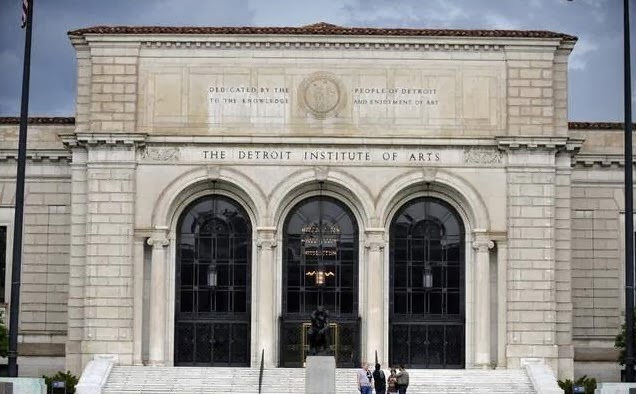
1.Detroit Institute for Art Makes Move to Engage State to Acquire Its Art
 DETROIT: The New York Times’s Randy Kennedy finally provides an inkling of the real story beneath the struggle over the Detroit Institute of Arts’s collection. To recap, the city bought much of the art contained within the museum. The region is eager to keep a world class museum. The surrounding counties have responded with alacrity by footing the museum’s operating costs with local taxes.

The only remaining issue has been how to help the City of Detroit realize the gain in value from the art it purchased without actually selling the art. This, not a philistine distaste for art as so many critics have leapt to assume, has been the real issue. Although it is never ideal for a museum’s collection to be treated as financial asset, the situation was created long ago. Now the Detroit Institute of Arts is putting the issue squarely on the table by appealing to the state of Michigan directly to save the museum’s art. If the proposal moves further, it will be a political victory for Emergency Manager Kevyn Orr who has been playing some very high level chess: The new proposal would ask the state to begin providing substantial funding to the museum that would allow the museum to provide money to the city that might otherwise be found only by selling art. At a business luncheon on Thursday in Detroit, Mr. Orr said that the museum might consider long-term leases of art works as another way of avoiding any sale. “I’m deferring to them to save themselves,” he told business leaders, referring to the institute.
The museum’s proposal for state help was described as a political long shot by many leaders
interviewed by the Detroit Free Press, who mentioned the competing demands for state money and the sensitivities over a city institution changing hands. “At first blush it sounds like it satisfies Kevyn Orr’s bottom line,” said Bert Johnson, a Democratic state senator, “but the continued divestiture of Detroit’s assets itself is implausible for me.”
Detroit Institute of Arts Mulls Transfer to State (Artsbeat/NYTimes)

2. NEW YORK At a packed, two-hour meeting at Manhattan’s Grolier Club last night, art dealers, museum curators, and other art world types sat rapt as a panel of high-profile experts held forth on the Detroit municipal bankruptcy filing and its possible implications for the billion-dollar-plus collection of the Detroit Institute of Arts.

What became clear during the panel, which was organized by the International Foundation for Art Research (IFAR) and moderated by its executive director, Sharon Flescher — and during the lively question-and-answer session that followed, in which organized art-world resistance and Nazi looting were invoked — was that those who oppose breaking up the collection are right to be worried.

This past spring, alarm bells went off in the art world when Kevyn Orr, the emergency manager appointed to oversee the city’s finances by Governor Rick Snyder, said that the DIA could “face exposure to creditors” if the city filed for bankruptcy — as it proceeded to do in July. Although a spokesman for Orr told the Detroit Free Press that “We have no interest in selling art,” he also said that the DIA’s collection would be considered part of the city’s assets, and in August Orr hired Christie’s to appraise some of the massive collection, a move that drew outrage from many observers. That $200,000 task was supposed to have been completed by the middle of this month but is still ongoing, the emergency manager’s office confirmed.

Left to right: Frank Robinson, Richard Levin, Graham W. J. Beal, Samuel Sachs II (photo by Steven Tucker)

The panel featured Graham W.J. Beal, the director, president and CEO of the DIA since 1999; Samuel Sachs II, the museum’s director between 1985 and 1997, and currently president of the Pollock-Krasner Foundation in New York; Richard Levin, a partner at Cravath, Swaine & Moore who is advising the DIA; and Frank Robinson, a former director of the Johnson Museum of Art at Cornell University, the Museum of Art at the Rhode Island School of Design, and Williams College Museum of Art.

Sachs kicked off the discussion by providing an overview of the DIA’s history, explaining how the 128-year-old institution came to be city-owned and “how we got here today.”  In  1919, he explained, when a group of enthusiastic citizens known as the “founder’s society” merged the museum with the city government, there were numerous benefits; the founders were freed to focus on matters like acquisitions and exhibitions while the city, one of the wealthiest and fastest-growing in the U.S., could be counted on to supply things like “floor wax and museum guard uniforms.”  (Another benefit was forestalling a planned 25-cent admission fee.) It was “a marriage made in heaven, as long as both parties had money,” Sachs said, and one that actually served to preserve and protect the collection. “I will talk in a few seconds about the wheels coming off the bus,” he added.

Beal said the museum has received confusing and mixed messages in recent months. “As soon as talk became serious about bankruptcy and the collection as an asset became obvious to everyone, we harbored what turned out to be forlorn hopes that the governor would decide it was politically the bravest thing to do to take [the collection] off the table. But he took another course; he decided, I presume, to take the emergency manager’s advice to leave us on the table.”

Many in the audience were surprised to hear Beal say that neither he, nor his chairman, has ever yet had a meeting with Orr. “From my point of view, it’s very strange,” he said.

Beal said he and his team have had several meetings with restructuring specialists. “We have spent considerable time doing our due diligence and looking at the possibilities of what might be feasible.” Beal said renting or loaning parts of the collection is an experiment the museum has tried in the past, but that it is not a viable way of monetizing the collection. He also noted that a lengthy report issued by the state’s attorney general in June had weighed in on the matter, saying that the DIA collection “may be owned by the city of Detroit but that it’s held in the public trust and as such, cannot be used to settle the city’s debts.”

 “After that [report], it becomes much murkier,” Beal said. His attempts to arrange a meeting with Governor Snyder have been met with “an effective stiff arm,” he said, and “in a way we are kind of i
n a cloud of unknowing.”

Levin, the Cravath partner, provided an excellent overview of how complicated the situation is, particularly by laying out how specific the laws regarding a municipal bankruptcy are, in contrast to those of a commercial bankruptcy. “Neither congress nor the court can interfere with any of the city’s properties or revenues — it’s a very important limitation that is not present in any commercial bankruptcy,” Levin said. And “only the emergency manager, not the court and not the creditors, can decide whether to sell the collection.”  (This decision, he added, is subject to two important constraints: what state law says about the emergency manager’s authority to sell; and the fact that the emergency-manager statute stipulates that the sale of assets valued at over $50,000 requires final approval from the governor.)

Levin said the attorney general’s report that the art cannot be sold to settle city debts, may be “persuasive, but not binding” for a court. Assuming Orr pushes for a sale, “some court is going to have to decide whether the attorney general’s opinion is right and the art is protected or not. Creditors will disagree. The matter is going to have to be litigated.”

During the Q&A session that followed, an audience member asked whether conditions could be imposed on a sale, such as partial ownership interest, by which the museum would retain some rights to the works, or limitation of a transaction to an institutional buyer. Levin reiterated that any plan would have to come from emergency manager Orr. Many art experts, meanwhile, suggested that any attempt to sell the art would be met with an art-world boycott, and that no major museum would even touch these works on principal. Walter Liedtke, curator of European paintings at the Metropolitan Museum of Art, sitting in the audience, said: “The important thing to say is that institutions like yours, like my museum — the curators in my department would all resign if the Metropolitan Museum placed a single bid for any one of your objects, even in another department. I know that’s true.”

New York dealer Richard Feigen ratcheted up the evening’s rhetoric by likening the possibility of a sale to a notorious 1939 Nazi sale of “degenerate art” at Galerie Fischer in Lucerne, the shadow of which still looms over the respective works today. He rejected one audience member’s suggestion that an interested buyer, then or now, might feel they were saving or protecting the works. “The Nazi regime took them off the wall and put them up for sale. Theses were things for which they thought they could get money.”

And David Nash, another New York dealer, argued that the idea of the art world heroically resisting a sale was unrealistic. “I would like to like to think that,” he said. But even if American institutions and collectors refused to buy “there are dozens of very rich buyers outside the country, including in Qatar, Russia, and perhaps China” that might step up.

Saturday, November 23, 2013

Exciting New Discoveries in Archaeology

Early in my career I had the opportunity to meet and spend some time with both Richard Leakey and Don Johanson. In recent years I have had the challenge and honor to appraise "Lucy"  the famous hominid discovered by Johanson on November 24, 1974 in Hadar, Ethiopia. I was hooked and have been fascinated by paleoanthropology ever since.  This new discovery stirs a debate that fundamentally re-orients the thinking about early man, As a consequence there are passionate differences of opinion which we as observers are the big winners in being privileged to watch this fascinating exchange. I am certainly not an expert in this area but it seems to me greatly simplified the debate is about how many branches we have in our family tree. Do we have multiple distinct species with many branches or do we have fewer branches with more diversity among fewer branches and fewer distinct species?


1. WASHINGTON (AFP).- A stunningly well-preserved skull from 1.8 million years ago offers new evidence that early man was a single species with a vast array of different looks, researchers said Thursday. With a tiny brain about a third the size of a modern human's, protruding brows and jutting jaws like an ape, the skull was found in the remains of a medieval hilltop city in Dmanisi, Georgia, said the study in the journal Science. It is one of five early human skulls -- four of which have jaws -- found so far at the site, about 100 kilometers (62 miles) from the capital Tbilisi, along with stone tools that hint at butchery and the bones of big, saber-toothed cats. Lead researcher David Lordkipanidze, director of the Georgian National Museum, described the group as "the richest and most complete collection of indisputable early Homo remains from any one site." The skulls vary so much in appearance that under other circumstances, they might have been considered different species, said co-author Christoph Zollikofer of the University of Zurich. "Yet we know that these individuals came from the same location and the same geological time, so they could, in principle, represent a single population of a single species," he said. The researchers compared the variation in characteristics of the skulls and found that while their jaw, brow and skull shapes were distinct, their traits were all within the range of what could be expected among members of the same species. "The five Dmanisi individuals are conspicuously different from each other, but not more different than any five modern human individuals, or five chimpanzee individuals, from a given population," said Zollikofer. "We conclude that diversity within a species is the rule rather than the exception." Under that hypothesis, the different lineages some experts have described in Africa -- such as Homo habilis and Homo rudolfensis -- were all just ancient people of the species Homo erectus who looked
different from each other. It also suggests that early members of the modern man's genus Homo, first found in Africa, soon expanded into Asia despite their small brain size.
"We are thrilled about the conclusion they came to. It backs up what we found as well," said Milford Wolpoff, a paleoanthropologist at the University of Michigan.
Wolpoff published a study in the journal Evolution last year that also measured statistical variation in characteristics of early skull fossils in Georgia and East Africa, suggesting a single species and an active process of inter-breeding. "Everyone knows today, you could find your mate from a different continent and it is normal for people to marry outside their local group, outside their religion, outside their culture," Wolpoff told AFP. "What this really helps show is that this has been the human pattern for most of our history, at least outside of Africa," he added. "We don't have races. We don't have different subspecies. But it is normal for humans to vary, and they have varied in the past."

But not all experts agree.

"I think that the conclusions that they draw are misguided," said Bernard Wood, director of the hominid paleobiology doctoral program at George Washington University. "What they have is a creature that we have not seen evidence of before," he said, noting its small head but human-sized body. "It could be something new and I don't understand why they are reluctant to think it might be something new." In fact, the researchers did give it a new name, Homo erectus ergaster georgicus, in a nod to the skull as an early but novel form of Homo erectus found in Georgia. The name also retracts the unique species status of Homo georgicus given to the jaw that was found in 2000 along with other small, primitive skulls. The jaw lay a few meters (yards) from where Skull 5, belonging to the same owner, was later discovered in 2005. Co-author Marcia Ponce de Leon of the University of Zurich said Skull 5 is "perfectly preserved" and "the most complete skull of an adult fossil Homo individual found to date." Its discovery, in such close quarters with four other individuals, offered researchers a unique opportunity to measure variations in a single population of early Homo, and "to draw new inferences on the evolutionary biology" of our ancestors, she said. © 1994-2013 Agence France-Presse

2. CAIRO (AFP).- Archaeologists have unearthed a 4,000 year old tomb outside the Egyptian capital containing what they believe are the remains of a prominent doctor to the pharaohs, officials said on Tuesday. The tomb, part of a 21 metre (70 foot) by 14 metre (46 foot) plot, with four-metre (13 feet) high
walls, was discovered at Abusir, southwest of Cairo, senior antiquities ministry official Ali al-Asfar said.
"This discovery is important because this is the tomb of one of the greatest doctors from the time of the pyramid builders, one of the doctors closely tied to the king," Antiquities Minister Ibrahim Ali said in a statement.
Asfar said the area in which the grave was found appeared to be a family plot and the Czech team of archaeologists was now looking for mummies of relatives.
Abusir, a vast necropolis dating back to Egypt's Old Kingdom, houses the pyramids of several pharaohs of the Fifth Dynasty, which began its rule shortly after 2,500 BC.

Auction Market Analysis Fall 2013


1. NEW YORK  Next month we will see the return of some big Warhol’s to the market. A liz and silver car crash at Sotheby’s; Christie’s leads with a Coca Cola bottle among six other million-dollar pieces in the evening sale. Liz, Car Crash and Coke all have good shots as making this list and changing the order. But before that happens, let’s update what is one of the more popular posts on Art Market Monitor:
1. Eight Elvises (1963) – $100m   In October 2008, Warhol’s Eight Elvises painting was sold in a private sale via French art consultant Philippe Ségalot for a price of $100 million, a record for
Warhol’s work.
2. Turquoise Marilyn (1964) – $80m  In May 2007 the painting, one of Warhol’s several portraits of Marilyn Monroe, was purchased by art collector Stephen A. Cohen in a private sale from
Dtefan Edlis via Larry Gagosian for a price believed to be $80 million.
3. Green car Crash (Burning Green Car 1) (1963) – $71.7m   Also in May 2007, this painting was sold at a Christie’s auction in New York for a then-record auction price of $71.7 million to art
collector Philip Niarchos, son of the Greek shipping magnate Stavros Niarchos.
4. Men In Her Life (1962) – $63.4m  In 2010 the black and white portrait of Elizabeth Taylor, pictured with both her third husband Mike Todd and future husband Eddie Fisher, sold to an
anonymous buyer at a New York Phillips de Pury & Co auction for $63.4 million. The work was consigned by the Mugrabi family.
5. 200 One Dollar Bills (1962) – $43.8m  In November 2009 the painting was sold at a Sotheby’s auction to an anonymous buyer for $43.8 million. It was sold by London-based art collector
Pauline Karpidas, who had purchased the work in 1986 for a mere $385,000.
6. Statue of Liberty (1962) — $43.8m  Christie’s sold this 3D version of the Statue of Liberty in November of 2012.
7.  Four Marilyns (1962) — $38.245m Phillips scored with this Mugrabi work in the Spring of 2013 which was bought by a dealer who works for Gagosian Gallery.
8. Double Elvis (Ferus Type) — $37m  This Sotheby’s lot sold in the Spring of 2012 but the second registration of the image was so faint that one wag called it Elvis 1.1
9. Coca Cola [4] (Large Coca Cola) – $35.36m  The painting sold in November 2010 at a Sotheby’s auction in New York for a price of $35.36 million to Steven Cohen who seemed to have gotten a
bargain at the time.
10. Self Portrait (1986) – $32.5m In May 2010 the large self-portrait by Warhol, painted in 1986 just a year before his death, was sold in a Sotheby’s sale in New York for $32.56 million.
The original list was compiled here: Top 10: Andy Warhol Paintings

2.NEW YORK (AFP).- The last of four in a series of Andy Warhol paintings depicting car crashes shattered the pop artist's auction record Wednesday, selling for more than $105 million, Sotheby's said. Silver Car Crash (Double Disaster), signed and a part of his 1963 Death and Disasters series, fetched $105,445,000 with three bidders vying for the buy in New York, the auction house said in a statement. The 2.43 m tall and 4-meter (over 8x13 feet) wide work, has two panels: to the left a series of 15 images of a car crash, and to the right, a large silvery rectangle. It is an imposing work experts describe as trailblazing and a cinematic allusion to death on a silver screen.
The previous top sale for the enigmatic pop artist and son of Polish immigrants, who was born Andrej Varhola in Pittsburgh, was $71.72 million, Sotheby's said.
The Sotheby's auction comes just a day after a triptych by British painter Francis Bacon -- "Three Studies of Lucian Freud" -- sold for $142.4 million, setting a new world record for the most expensive piece of art auctioned. That work by Bacon, the 20th century figurative artist, who lived from 1909 to 1992, had never before been put under the hammer until Christie's flagship evening sale. It was bought by a New York gallery. The most expensive artwork ever is a Cezanne that sold for $259 million in 2011 in a private sale.
Hammered to an outburst of applause, the Bacon surpassed the previous record of $119.9 million fetched by Edvard Munch's iconic "The Scream" by rival house Sotheby's in New York in May 2012.

3. NEW YORK Artnet: Top Ten Artists for 2013 (So Far)
 The top 10 artists in 2013, by value sold at auction Q1–Q3, include:
1. Pablo Picasso (Q1–Q3 2013 sales: US$233.7 million)
2. Zhang Daqian (US$206.6 million)
3. Jean-Michel Basquiat (US$169.4 million)
4. Qi Baishi (US$168.1 million)
5. Andy Warhol (US$143.1 million)
6. Gerhard Richter (US$124 million)
7. Claude Monet (US$112 million)
8. Roy Lichtenstein (US$102.3 million)
9. Amadeo Modigliani (US$91.3 million)
10. Jackson Pollock (US$79.6 million)
In Q3 (the weakest quarter for auctions) sales were up 20% in the US and 30% in Japan:
Elsewhere, the art market continued to track global financial trends with the United States exhibiting steady growth, while art markets in China and the United Kingdom slowed. Christie’s New
York was up 42% in Q3, followed by an 18% growth in value sold at Bonhams. Similar performance was seen across the board, with Heritage Auctions, Freeman’s, Leslie Hindman Auctioneers,
and Neal Auction Company showing considerable growth in both volume and value sold in other American cities.
Even with slow economic activity across Europe, successful auctions in Italy, Ireland, and Spain have contributed to Q3 growth, suggesting that the European art market as a whole may be
stabilizing.
Several London auction houses are still lagging behind 2012 performance, with the entire UK region down 7% in Q3 2013.
Artnet Q3 Trends Press Release

4. NEW YORK New York Impressionist-Modern  Round Up
The Impressionist and Modern sales in New York were a rollercoaster of emotions for collectors and market watchers as the week moved from seeming market weakness to something more resembling strength. Perhaps the best indicator of demand in the category was not the attention-grabbing collections that led the Evening sales but the performance of the Zieseniss collection and the Day sales. Those 8 works made $18m mostly beating their estimates; the next day, Sotheby's saw more strong sales for works by Chagall, Monet, Caillebotte, Renoir and others. Most of the top ten works in Sotheby's day sale easily exceeded their estimates. The same was true with Christie's day sale were the bulk of the top lots were at prices above the estimates. Even the Krugier sale was able to score top
positions for the works that held relatively low estimates.
Christie’s NY Imp-Mod & Jan Krugier = $293.6m
Sotheby’s NY Imp-Mod = $348m
 Does Sotheby’s Imp-Mod Success Satisfy Wall Street?
The Financial Times gathered a reaction to Sotheby’s resounding success in the Impressionist and Modern market this week. They asked analysts if the results would change their view of the company’s prospects:
“Its clear that bidders saved their bids for Sotheby’s this week, with most higher value lots going for well above their expected range,” noted Oliver Chen, luxury analyst at Citigroup. “However, questions still remain over what auction commission margins these items were sold at.”
Headlines sum it up...
Sotheby’s trumps Christie’s in New York autumn auction season (Financial Times)
Sotheby’s Restores Market Confidence with $290m Imp-Mod Sale (Financial Times)
 Giacometti, Picasso Help Sotheby’s Tally $290 Million (Bloomberg)
Strong Mix of Art Propels a Fine Night at Sotheby’s (NYTimes)
Sotheby’s Soaring Night (Artinfo)
Sotheby’s Nets Impressive $290.2 M. at Steadily Paced Imp-Mod Sale (GalleristNY)
Sotheby’s Strong Sale Anchored by $50 Million Giacometti Bronze (Wall Street Journal)
Asian Buyers Draw Attention While ‘Masterpieces’ Languish at Christie’s Imp-Mod Evening Sale
 Giacometti Fetches Record $33 Million in Listless Auction (Bloomberg)
Collectors Turn Picky at Christie’s Limp Sale (Wall Street Journal)
Lackluster Bidding Dampens Second Night at Christie’s (NYTimes)
Top Lots Fail at Christie’s Disappointing $144m Imp-Mod Sale (GalleristNY)
Christie’s Regains a Bit of Traction in Tuesday Sale (artinfo)
 Picasso’s Claude & Paloma Sells to China’s Top Billionaire (Bloomberg)
 Bloomberg is reporting identity of one of last night’s buyers at the Jan Krugier sale:
China’s richest man, Wang Jianlin, bought Picasso’s painting of his young children, Claude and Paloma, for $28.2 million at Christie’s in New York yesterday, the auction house said.

5. 1. NEW YORK, NY.- The week of Asian Art sales at Sotheby’s New York concluded today bringing a total of $74,077,814, more than doubling the combined low estimate (est. $30/43 million).* There were excellent results in all sales with strong prices for two thousand years of Asian Art spanning from Archaic Chinese Bronzes to Modern Indian Paintings. The highest price of the week’s sales in New York was realized when The Gong Fu Tie Calligraphy by Su Shi, one of the towering figures of early Chinese history, sold for $8,229,000.

6.  SHANGHAI (AFP).- Christie's held its first independent auction in mainland China Thursday with artworks including Pablo Picasso and Andy Warhol, marking its full-fledged entry into a market considered a key growth engine for global art sales. Hundreds of people attended the auction as more than 40 items -- from Western masterworks and Asian contemporary art to jewellery, watches and wine -- went under the hammer to fetch 153 million yuan ($25 million). Christie's, which has long operated in Hong Kong, had been organising sales in China since 2005 by authorising a Chinese auction firm to use its international trademark, due to strict regulations on setting up a solely-foreign invested auction house. But the firm said in April it had become the first international auction house authorised to operate in mainland China without a local partner. he house now expects "to connect Shanghai and therefore mainland China into Christie's network" which includes New York, London, Paris and Milan, Murphy said on Tuesday as it unveiled a three-day exhibition of the auction items ahead of the sale.
China emerged as the world's largest art and antiques market with a 30 percent share in 2011, narrowly overtaking the United States for the first time, according to the European Fine Art Foundation. It reverted to second place in 2012 with a 25 percent global share as the US regained the top spot with 33 percent, the art fair organiser said in a March report.
Christie's, one of numerous business interests of French billionaire Francois Pinault, was at the centre of controversy in 2009 when two bronze animal heads looted from Beijing's Old Summer Palace in 1860 were put up for auction in Paris. The animal heads were then owned by Pierre Berge, the partner of late French fashion designer Yves Saint Laurent, until Pinault acquired the two bronzes and handed them back to China in June this year. © 1994-2013 Agence France-Presse

7. HONG KONG.- Commenting on Sotheby’s Hong Kong 40th Anniversary Evening Sale, Sotheby’s Chairman and Chief Executive Officer Bill Ruprecht said, “Sotheby’s was at the top of its game, performing impeccably and making the most of an incredibly robust Asian art market. We saw the excitement of 11 world records as multiple bidders from around the world competed for exquisite works.”
Kevin Ching, Chief Executive Officer of Sotheby’s Asia, said: “This evening’s sale was a fitting achievement to celebrate our company’s 40 years in Asia. Our extensive global network of specialists sourced and sold rare, remarkable and fresh-to-the-market works from important collections around the world. With nearly 700 people in a standing-room-only saleroom, and many competing by phone as well, both new and established collectors responded enthusiastically to the unique opportunity to acquire works of superb quality across the categories of 20th Century Chinese Art, Contemporary Asian Art and Modern and Contemporary Southeast Asian Art. Bidding came from 25 countries in a sale which achieved the highest total for any comparable sale in Asia, more than doubling the previous record*. Five bidders competed for more than fifteen minutes for Zeng Fanzhi’s The Last Supper, a 2001 oil-on-canvas, and applause broke out several times before the work sold for HK$180,440,000 / US$23,273,151 and set a record for a work of Contemporary Asian Art and for the work of a living Chinese artist. The sale also set records for ten other artists including Zao Wou-ki, Liu Ye, Pan Yuliang, Walter Spies, Ay Tjoe Christine, Chen Wen Hsi, Juan Luna, Cesar Legaspi, Georgette Chen and Rudi Mantofani.”
**Previous record of any comparable sale in Asia: HK$492,660,000 / US$63,306,810.